Why Stories Matter
You cannot change the law without changing the stories we tell about the law
Mandira Kalra Kalaan, Senior Director & Head of Office, India
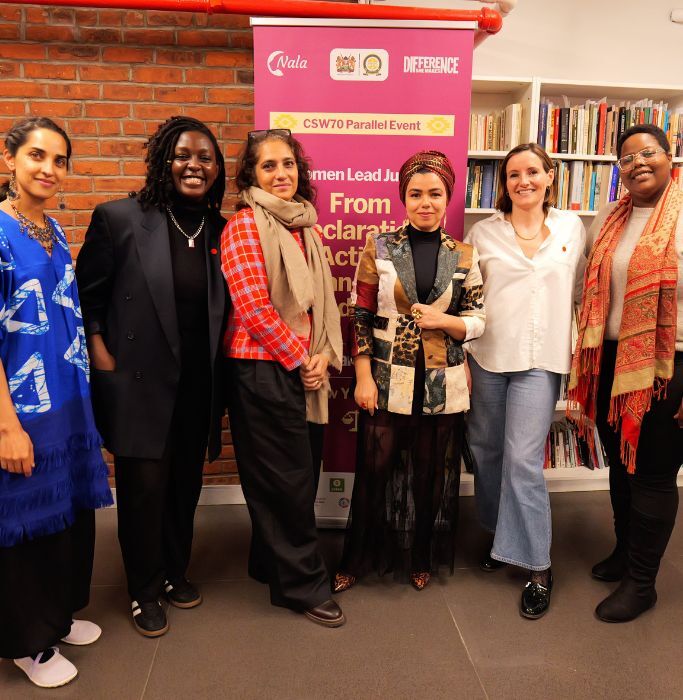
CSW70 (Commission on the Status of Women) was held in New York just a few weeks ago. I’ve been sitting with it – the stories I heard, the sessions I attended, the conversations I had – for some time before trying to put my thoughts down. A week like CSW70 deserves more than just a quick recap — and because the moment we are in deserves more than polished conference optimism.
So let me start with where we actually are.
Women hold just two thirds of the legal economic rights that men have. Only 12% of presidents are women. A mere 3% of venture capital goes to female founders. And at the current pace, it will take 300 years to close the legal equality gap between women and men.
Three hundred years. That number kept surfacing across sessions, in different voices, in different rooms. It is not an abstraction. It is a political choice — a verdict on how seriously the world takes this — and it is one we have the power to change.
What makes this moment feel different, though, isn’t just the scale of the gap. The last two years have seen something more insidious than the usual geopolitical headwinds: power and influence and information are now consolidated in the hands of a small minority, platforms and algorithms decide whose voices are amplified and whose are silenced. The dismantling of gender equality infrastructure — institutions, funding, legal frameworks — has happened alongside this consolidation of power. That is not a coincidence. These things are connected.
Two Roads
UN Women Executive Director Sima Bahous opened CSW70 with an image that stayed with me throughout the week. She described two roads — one representing the needs of women and girls, the other the justice system — and the profound transformation that becomes possible when they actually meet. But she was equally clear about the reality when they diverge: in nearly 70% of surveyed countries, women face greater barriers to justice than men. In 54% of countries, rape is still not defined on the basis of consent. In 75% of countries, a girl can still be forced to marry.
CSW, she said, is about solutions. But more than that, it is about the political will for those solutions to actually be implemented. That framing — the gap between what exists on paper and what people actually experience — ran like a thread through every session I attended.
What the Sessions Showed
The World Bank 2026 Women Business and the Law report, released during CSW, has made an important evolution from previous editions. It no longer just catalogues what laws exist on paper — it now scrutinises whether implementation systems actually work. Tea Tumbric put it simply: ‘laws are just a suggestion without strong mechanisms to make them a reality.’ Robin Mearns, the World Bank’s gender lead, added that durable change requires all three things together — reform, implementation, and a genuine mindset shift in how we understand women’s roles in the economy, in care, and in public life. None of those alone is sufficient.
At another session on Women’s Leadership in Justice and Law a related argument was made. Women judges are not simply a representation milestone — they actively drive institutional reform, build public trust, and change what justice looks like in practice. But the session was honest that appointment alone is not enough. The structures around those judges must change too, or you are simply setting people up to survive rather than thrive. As the International Association of Women Judge’s (IAWJ) Amie Lewis said, in a line I haven’t stopped thinking about: ‘if you are not a judge, amplify their stories.’ Narrative change, she was arguing, is not separate from structural change. It is part of it and they go hand in hand.
The Care and Climate side event, convened by the Climate and Care Initiative at the UN, turned out to be one of the most clarifying sessions of the week. The central argument is both simple and underappreciated: care systems are climate infrastructure. As climate change intensifies — through floods, droughts, displacement, and health crises — unpaid care burdens grow, and those burdens fall disproportionately on women. Yet care barely features in climate finance frameworks or national adaptation plans. A just transition that ignores care is not, in any meaningful sense, just.
Multiple sessions and conversations centered on the backlash against gender justice directly, and they painted a picture that I think anyone working in this space needs to sit with. Researchers, policymakers and practitioners all spoke about the growing, organised pushback against gender equality and women’s access to justice — and to think seriously about strategic responses. Other sessions traced how far-right movements are coordinating across borders, manufacturing crises to justify securitisation, and deliberately targeting gender rights, queer existence, and the movements and institutions working to protect them.
What these sessions underscored is something that I have been thinking about for some time: the backlash is not spontaneous. It is not simply a cultural reaction. It has architecture — it is planned, resourced, and strategic. Understanding that architecture is as important as anything else we do. Alongside this, one of the more uncomfortable data points of the week: young men aged 15-24 are currently among the most conservative groups on gender equality. That is not a reason for despair. It is a reason to be more deliberate — about who we are reaching, how we are reaching them, and what narratives we are putting into the world.
The Reykjavik Global Forum and the Gates Foundation reminded us that ‘you cannot treasure what you don’t measure.’ Data is not neutral, but it is necessary. Progress requires evidence, trusted messengers, and the courage to act on what the evidence shows — including the findings that are inconvenient or uncomfortable.
The Story We Tell
This is what I kept coming back to across the week, and what I tried to articulate at our own event — The Difference She Makes. The campaign is built on the idea that representation is the entry point, not the destination. The real question is not just who sits in the chair — it is what the chair does, what the institution becomes, what justice looks like in practice once women are in the room and shaping decisions.
But getting there requires more than policy reform and legal change. It requires what I’d call cultural legitimacy — a shift in the stories people tell about what leadership looks like, what justice requires, and what is possible. Narrative change is the mechanism. It softens the ground, invites new allies, and widens the social imagination of what can exist. It takes the data, the advocacy, and the lived experience and weaves them into something that can actually move people — turning information into meaning, resistance into readiness, and isolated efforts into collective momentum.
The anti right movement understands this. The rollback of gender equality infrastructure has been accompanied, everywhere, by a deliberate effort to change the story — to reframe feminism as threat, equality as ideology, and care as weakness. Our response has to operate at the same level.
You cannot change the law without changing the stories we tell about the law.
Sima Bahous closed her address with something that has stayed with me: there is no pushback stronger than our collective efforts, no regression more powerful than our movement’s momentum. I am holding onto that — not as comfort, but as a call to action.
The conversations in New York, the solidarity in those rooms, the clarity of people who understand exactly what is at stake and are showing up anyway — that gave me something real. Not naive optimism. But instead the kind of hope that comes from being in spaces that refuse to normalise hierarchy and inequity, that dare to imagine something different, and that are doing the actual work of making it real.
The backlash is real. So is the resistance.
We don’t have 300 years. We need to act like it.