What Mumbai Taught Us About Building a Climate Community That Lasts
Reflections from Mumbai Climate Week
Sonali Bhasin, Associate Strategy Director
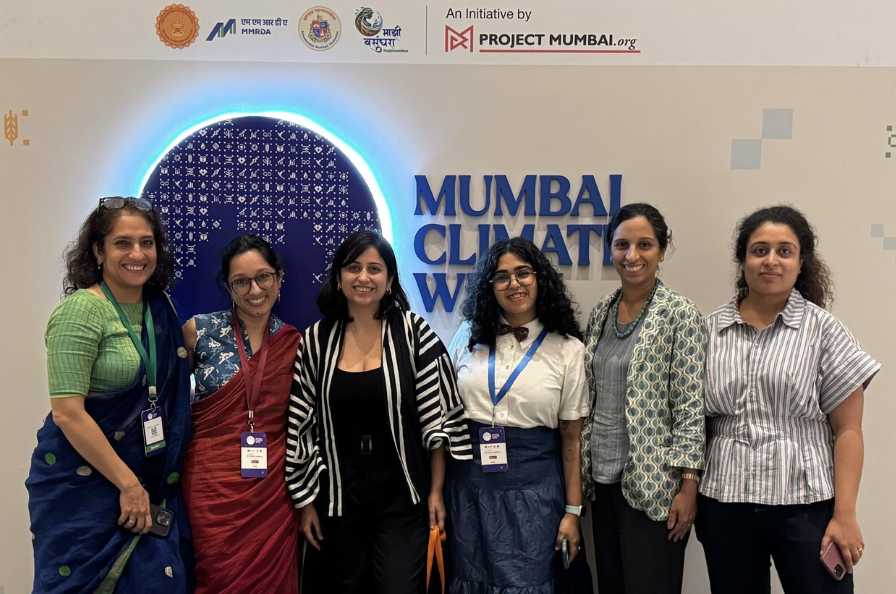
Mumbai’s first Climate Week marks a first for the city, the country, and the region: a signifier that Global Majority countries are ready to lead climate action, and the emergence of a climate leader in South Asia.
Between COP and Climate Weeks in cities like New York and London, many practitioners from developing countries have been kept out by visa requirements, financial constraints, and access to closed-door meetings. Mumbai Climate Week, while still in one of the fanciest convention halls in the country, invited practitioners from Global Majority countries to create their own space, and develop an agenda based on their priorities.
The Mumbai Climate Week agenda was telling of where the sector’s priorities lie: the emphasis was on extreme heat, financing for transitions, decarbonisation, mobility, and circular systems. Absent were conversations around just transition, adaptation, and urban waste or air pollution. But while some sessions felt like a reassertion of what the climate sector already knows, other, smaller sessions were electrifying. Breakthroughs in EV technology, calls for participatory data for extreme heat, and conversations that asked climate philanthropy tough questions about project sustainability: all were critical and inspiring.
At MCW, Purpose hosted three events that represent the kind of spaces we wish to see more of: a pre-Mumbai Climate Week convening on urban waste that celebrated local heroes and solutions; an after-hours gathering of communicators and food experts designed to foster free conversation, and a plenary session on participatory action in climate, co-hosted by Purpose and partners.
At Solutions That Work, a pre-MCW event hosted by the Global Methane Hub and Purpose, practitioners, policymakers, and researchers came together to highlight the existing solutions to waste management that need to be scaled in Mumbai. The Deputy Municipal Commissioner of Solid Waste Management, Mr. Kiran Dighavkar, reminded us that the government alone cannot make changes, and that an active civil society is the key to change in any city. “It is civil societies who catalyse the change, and citizen engagement that is critical to the success of any policy”
During our Chai in Mumbai session, a gathering of communicators and practitioners associated with our Hands of Transition network, we met filmmakers, entrepreneurs, scientists, and writers who were seeking a community for the work they are doing in the food space. They shared how difficult it is to find spaces to collaborate, spaces without a fixed agenda, that are not limited by access to resources or funding.
Our final plenary session, co-hosted by Purpose and partners, featured women from GIZ, EDF, WOTR, and independent journalism in conversation with Mandira Kalra Kalaan, Senior Director, and Head of Purpose’s India Office. The session was built around a deceptively simple provocation: what does participatory action in food systems actually look like when it works? Neha Khara of GIZ India made the observation that stuck with us most. She said that “Communities are not beneficiaries of climate programmes. They are long-term system actors”.
MCW was host to a slew of commitments to climate finance, energy transition, and green public transport by the Maharashtra government. Weeks later, India announced its new NDCs for 2035, pushing our non-fossil fuel capacity to new heights, and committing to new target sinks. I’d like to think this marks the kind of momentum and shared ambition that India needs.
Not only does MCW elevate climate conversations to national attention, but also gives the climate community a space to act like a community. To collaborate across sectors, broker new partnerships, and to end each day in informal spaces where we can laugh, commiserate, and dream together – the kind of care and support that every social impact community needs. It provided the climate sector a new level of visibility, and provided the climate community an opportunity to celebrate each other.
Marcella D’Souza of WOTR, a panelist on Purpose’s co-hosted plenary session captured something deeply important, “the voices with the deepest knowledge of ecological change — rural women, elders, people who have watched the same landscape across decades — are still largely absent from the rooms where decisions get made. Not because they have nothing to say, but because the rooms weren’t built for them.”
This truth persists long after the convening. While there is still much work to be done to ensure Mumbai Climate Week is shaped by the men and women on the frontlines of climate action, this felt like a meaningful step in that direction. It hinted at what becomes possible when those rooms begin to open, and when lived experience is not just acknowledged but welcomed and valued. Above all, this Climate Week left us with a strong sense of hope for a more grounded and inclusive climate movement going forward.