Three Years of Alli Serona
The Story of Women Leading Change at the Heart of Bengaluru’s Cityscape
Manav Seth, Copywriter & Digital Strategist
Three years ago, a new chapter quietly began in Bengaluru’s sprawling urban landscape—one that wasn’t defined by towering skyscrapers or smart city dashboards, but by the voices of women from informal settlements who had long been left out of conversations shaping the city around them. Now, as the Alli Serona initiative completes its third year, it is time to reflect on the profound journey these women have undertaken—a journey that reveals how everyday experiences and aspirations can transform cities from the ground up.
Beginning with What Matters Most: The Citizens’ Concerns
In 2022, Alli Serona brought together civil society organisations, local creators and community leaders to make the city more inclusive and future-ready, but at the centre of it all were the women from Bengaluru’s informal sectors and settlements. Their voices shaped the mission: to reimagine mobility and urban services through their eyes, experiences and aspirations.
The women and informal settlement residents, those who are closest to the realities of Bengaluru’s informal neighbourhoods, however, weren’t sure what to make of sustainability and rarely spoke about it. Climate change, while important at a global scale, was not the immediate concern for women juggling child care, domestic work and daily household chores under constraints shaped by social norms and limited freedoms. Instead, mobility emerged repeatedly as the thread connecting their lives, a basic need to safely and reliably reach workplaces, markets, clinics and schools.
Recognising this, Alli Serona began by stepping back to listen deeply, engaging women in focus group discussions that sought to understand what really shaped their daily choices and challenges. It emerged that mobility wasn’t just transportation; it was a gateway impacting safety, access to services, time management and ultimately livelihood security.
With this insight, the collective chose mobility as an entry point to discuss environmental and urban issues that resonated with everyday realities without imposing jargon or distant concepts. This approach also recognised that mobility itself has a substantial impact on pollution and the potential for low-carbon economies, but that such economies often exclude those on the margins if their voices and needs aren’t centred.
Women in these communities were quick to step forward when asked to lead efforts that had direct benefits for their families and neighbourhoods. Their participation was pragmatic and purposeful, informed by the complex interplay of care responsibilities and social limitations, yet guided by a commitment to improving everyday life.

The Alli Serona name, logo and identity were chosen and co-created by the women of the collective
Co-Creation as Foundation: The Bedrock of Alli Serona
From its inception, Alli Serona was designed not to be driven through external interventions, but as a community-rooted collective. The name Alli Serona (meaning “Let’s meet there” in Kannada) was chosen by the women themselves, a simple invitation that carries profound meaning. It speaks to connection, presence and agency in spaces that city planning had overlooked for too long.
The collective’s name, identity, logo and colours were also co-created with the women themselves, imbuing everything from branding to action with the colours, languages and symbols of the neighbourhoods they called home. This foundational step set a tone of respect, ownership and collaboration that united the women under the Alli Serona collective.
Central to the collective’s early work were participatory walking audits across nine informal settlements. Here, the women documented their daily journeys using specially-designed audit postcards that eschewed technical jargon in favour of simple, icon-based visuals that made mapping obstacles—from inaccessible bus stops and poor lighting to safety hazards—intuitive and inclusive.
The audits uncovered a persistent absence of nearby bus stops and safe, well-maintained routes. In response, the collective imagined a bold, creative solution: a mobile bus stop installation. More than just a structure, the bus stop became a symbol of dynamic communication and an engagement platform for the community to voice collective mobility challenges.
The Mobile Bus Stop: A Platform for Visibility and Voice
Boldly painted and decorated with motifs grounded in local culture, the bus stop installation toured four neighbourhoods, inviting community members to ‘vote’ for better public transport and sparking conversations with residents, media and policymakers alike. Through this participatory art and advocacy, an abstract issue about the lack of public transport became visible, tangible and firmly rooted in the residents’ everyday experience.
The installation did more than highlight transport gaps; it unveiled overlaps with safety, street lighting, public infrastructure and gender-responsive urban design. The mobile bus stop emerged as a symbol that could speak to a constellation of challenges and possibilities, all through the lens of the residents’ lived realities.
This creative advocacy translated into concrete outcomes. Over 3,700 community members engaged through votes and interviews, media coverage spanning English, Kannada and Tamil outlets, and critical stakeholders, including transport officials and government representatives, began to listen and act. Notably, the Bangalore Metropolitan Transport Corporation piloted three new bus routes in underserved informal settlements—an outcome directly shaped by the community’s voices.
Participatory and community-driven change: The emergence of PASI
The impact of Alli Serona has spread beyond the neighbourhoods where women first met. Their work caught attention, winning recognition like the Silver Award at the prestigious Anthem Awards in 2024 under the Community Engagement category. This honour not only enhanced visibility toward the collective’s unique approach but also became a testament to the resilience of these women that shaped the iconic mobile bus stop installation, both a literal and symbolic platform crafted by the women’s own ideas.
Furthermore, the success of the interactive bus stop installations sowed the seeds of a framework that would strengthen more People First Cities initiatives. The Participatory Art for Social Impact, or PASI framework, became a viable approach to transform communities into active contributors, co-authors and narrators of their own stories, empowering them to present their needs and aspirations through compelling art-based storytelling.
The installation led to the realisation that when art is created, presented and represented by the community, it not only amplifies their stories but also fosters ownership and agency. The Alli Serona collective’s successes show that PASI can enable social impact initiatives to go beyond mere visibility, enabling communities to stand stronger, speak louder, and actively co-create solutions alongside decision-makers and the broader ecosystem. Because it’s not just about the art—it’s about what the art unlocks: a shared vision for change, a louder voice and a deeper connection.
Expanding the Vision: Public Spaces as Extensions of Home
Building on the movement ignited by mobility, Alli Serona extended its reach to public spaces, recognising these as essential ‘third spaces’ beyond the home and workplace where community life unfolds. Informal settlements often lack safe, accessible areas where women and children can gather—a gap that limits quality of life and social cohesion.
Over multiple participatory workshops across Hosa Nagar, Vijayanagar, Byrasandra and Seegehalli, women assessed available spaces, voted on priorities and led neighbourhood transformations ranging from park clean-ups and renovations of childcare centres to campaigns advocating for better health centre infrastructure.
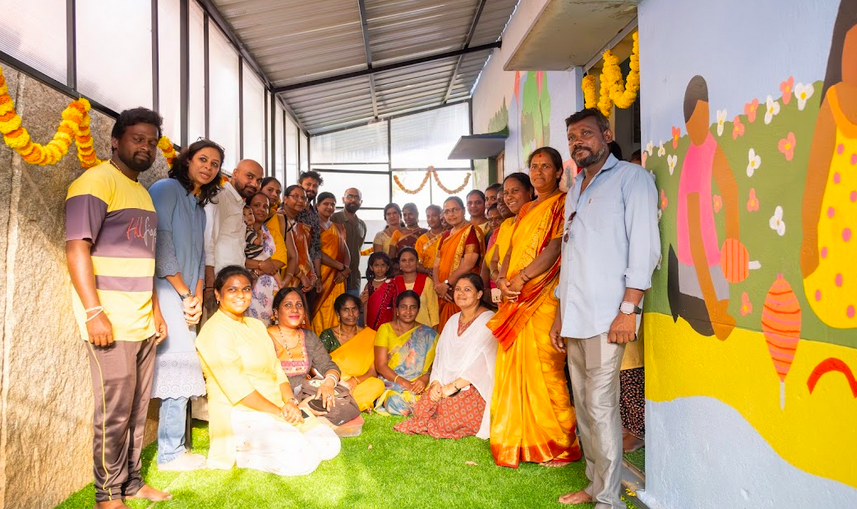
The Alli Serona women in Vijaynagar at the inauguration of the renovated courtyard at the local anganwadi centre
In Hosa Nagar, a neglected park was revitalised through community planting and cleanliness drives, supported by local municipal officials who responded to requests for benches, play areas and borewell connections. In Vijayanagar, women transformed an unused courtyard adjacent to an anganwadi into a colourful, sheltered play space featuring murals designed by a local artist and collective member. Byrasandra’s women boosted awareness about new bus routes through community campaigns that reached more than 2,400 residents, while Seegehalli’s petition drives and advocacy efforts focused on improving the Primary Health Centre and surrounding open spaces.
These collective efforts reflect a deep understanding: public spaces in informal settlements are not just physical areas but vibrant social and environmental assets that can foster community pride, safety and resilience. Moreover, these spaces are crucial extensions of home where cultural and social bonds are nurtured, especially important in neighbourhoods where traditional housing models often prioritise land tenure and construction over everyday human experience.

The Alli Serona women in Hosa Nagar at the inauguration of the revitalised public park with added shelter, play areas and benches
Anchoring a Movement Toward Inclusive Cities
What makes the Alli Serona journey so compelling is that it reframes the idea of urban transformation. Instead of implementing exported solutions, it emerges from collaboration with those most impacted. It challenges common urban narratives by insisting that informal workers and women, often excluded from policy and planning, are integral to low-carbon, equitable urban futures.
Behind every success—whether the mobile bus stop, a renovated park or a safer play area for children—are women who balance domestic work, childcare, jobs and community action. Their leadership is not symbolic; it’s rooted in practical knowledge and a deep sense of responsibility toward family and neighbourhood.
This recognition shapes Alli Serona’s ethos and sustained impact, and the collective has become a foundational model for wider initiatives like People First Cities, advocating participatory, people-centred urban design that is both inclusive and climate-responsive.
The story of Alli Serona’s women is one of agency and belonging, a demonstration that those living at the margins hold the insights, the creativity and the drive to build cities that serve them. This matters deeply, especially in rapidly evolving urban environments like Bengaluru, where informal settlements and their residents are often sidelined in planning processes.
Take Sweat & Concrete, for instance, a multi-media and sensory exploration of how the rising temperature is impacting informal sector workers. From documenting Venkatachala’s story to surfacing creative solutions for outdesigning urban heat, the exhibit demonstrates how platforming voices from the margins can result in inclusive solutions, better urban planning and effective policy making.
Looking Ahead: Growing Bengaluru from the Inside Out
As Bengaluru continues its journey as a climate-aware metropolis, the collective envisions a city that grows from the inside out. The aspiration should be to become a city where public spaces are accessible, safe and welcoming, and where mobility systems are designed around people’s realities. This vision takes along informal communities as the city transforms, empowering them as active contributors to city planning and sustainability.
Three years on, Alli Serona stands as a testament to what is possible when residents come together, not only to make themselves heard, but to lead change. The journey of the Alli Serona women reminds us that inclusive urban futures must be built on care, creativity, co-creation and respect for lived experience.
We are celebrating the three years of Alli Serona on 30 July, and convening the collective to look back on its journey and achievements. So, watch this space for more updates!
We would like to thank all partners and collaborators of Alli Serona and People First Cities for their valuable insights, immeasurable support and unparalleled expertise:
Association for Promoting Social Action (APSA) – Community partner
Bengawalk – Research partner & Video Producer
Aravani Art Project – Brand identity & creative partner
Flourish Shop – Handicraft & community engagement partner
Falana Films – Creative partner
Studio Sorted – Spatial design & creative partner
Auom Impact & Consulting – IML partner
Kahe Vidushak – Performance art partner
Ashoka Trust for Research in Ecology and the Environment (ATREE) – Community partner
Sustainable Futures Collaborative – Community partner
Hasiru Dala – Community partner
Jan Sahas – Community partner
Jan Pahal – Community partner
Flint Culture – Communications partner
The Migration Story – Communications partner
Young Leaders for Active Citizenship (YLAC) – Communications partner
This article was originally published on People First Cities – a social movement-building initiative aimed at helping make our cities more inclusive, accessible and sustainable.