Beyond the Commute
You cannot build a sustainable city on an infrastructure of exclusion
Kanishk Kabiraj, Strategy Director, Purpose
Stand at a busy intersection in Jakarta, Nairobi, or Nagpur, and watch how the city moves. Amid the din, the chaos, and the relentless heat, you will see a distinct pattern in who is moving, how they are moving, and how much it costs them.
This year marks the official start of the UN Decade of Sustainable Transport (2026–2035). Vital goals such as electrification of bus fleets, mass rapid transit, and decarbonization tend to dominate high-level summits and convenings on mobility and urban planning. Yet, following the recent UN Commission on the Status of Women (CSW70), which pushed for “care-responsive transport”, I am left reflecting on a quieter, more urgent reality which remains largely unaddressed by mega-projects: our cities were never designed for the people who actually stitch them together.
The geometry of exclusion
The history of urban design and its resulting dominant infrastructure in the Global South is that it feels poured and paved around a singular, specific user: The 9-5er. A formal worker, usually male, traveling from Point A to B (with some minor detours in between). We see this manifested in massive Outer Ring Roads, elevated expressways, and linear commuter corridors. These are monuments to the traditional commute, designed to move cars quickly or bypass neighborhoods entirely, rather than serve the granular reality of the people living inside them.
Women’s mobility needs in the Global South are fundamentally shaped by the care economy. A typical journey involves chaining together multiple, fragmented trips: dropping a child at school, navigating a crowded vegetable market, checking in on an elderly relative, and also making it to a place of work. We know the geometry of this disparity: World Bank data shows that women in the Global South make up to 15% more chained trips than men, a direct result of undertaking 75% of all care-related travel. Because formal transit systems are heavily optimized for this point-to-point commute, they ignore this multi-stop reality. And women are forced to rely on informal, fragmented networks to bridge the gaps. In rapidly sprawling secondary cities, the default becomes the ojek in Surabaya, the matatu in Meru, or the shared chaggra in Ranchi.
The persistent, invisible, mobility tax women pay
This reliance on fragmented transport is compounded by the sheer dominance of the informal economy. For example, over 90% of women workers in parts of South Asia and Sub-Saharan Africa are informally employed (ILO). The spatial reality of their daily lives is defined by stark urban segregation. In rapidly growing non-capital cities like Gurugram in India, Cebu in the Philippines, or Durban in South Africa, urban landscapes are hyper-fragmented: sprawling, under-resourced informal settlements often sit immediately adjacent to, or just across a dividing highway from, affluent gated colonies and corporate enclaves. The women residing in these marginalized settlements form the invisible backbone of the local economy, commuting daily to neighboring affluent blocks to work as domestic help, caregivers, or vendors. Yet, formal transit corridors completely bypass critical, short-distance, cross-neighborhood routes. A domestic worker in Gurugram trying to travel just three kilometers from a dense urban village to a luxury high-rise finds no bus route connecting her. Instead, she is systematically excluded by the formal grid, forced to navigate dangerous, unpaved peripheries on foot or surrender up to 20% of her daily income to paratransit just to cross the structural divide.
This extracts a heavy toll. Women pay a punishing premium, often frustratingly referred to as the ‘pink tax’ simply to navigate the city safely. Across the Global South, safety consistently ranks as the number one criterion for women’s travel choices—outranking cost, reliability, and comfort. To avoid the physical danger of an unlit, unpaved walk to a bus stop, women are forced to spend disproportionately high percentages of their income on private, motorized last-mile transport. In India alone, over 200 million women pay this invisible tax every morning just to step out of their doors.
Thinking beyond the economic argument
When policymakers attempt to solve this exclusion, they often rely on a prevailing macroeconomic argument that closing the workforce participation gap could add trillions to regional GDPs (and fixing transport is the key to unlocking this female labor).
But we need to look beyond these seductive numbers and ask what the cost is of framing women merely as stranded economic assets waiting to be leveraged. A right to the city is not just a right to access a factory floor or an office block. It is the right to leisure, to community gathering, and to exist safely in public space without having to justify your presence with economic productivity.
We see the limits of purely economic interventions in recent bus fare subsidy schemes across Indian cities. Making public buses free for women is a deeply welcome, progressive step that has halved transport costs for millions. Yet, extensive studies, including those we have anchored, show that a free ticket on the bus does not fix the hostile geography outside of it. If the three-kilometer walk to the bus stop remains unlit, unpaved, and unsafe, a purely economic subsidy will never bridge the structural transit gap.
From passengers to planners
Redesigning a city around “care” sounds expensive. Critics will inevitably argue that cities barely have the budgets to maintain standard bus fleets, let alone finance hyper-localized, multi-modal networks tailored to informal workers. However, this argument ignores the staggering economic and social cost of the status quo. Building massive, billion-dollar transit corridors that half the population cannot safely reach is not fiscal efficiency; it is an incredibly expensive form of exclusion.
Perhaps this is why shifting the focus of urban development and planning budgets to the lived experience, away from massive Transit-Oriented Development (TOD) will be key. Crucially, this cannot be mapped from a drafting table. The people who best understand the multi-modal complexities of a city are the women who navigate its blind spots every day.
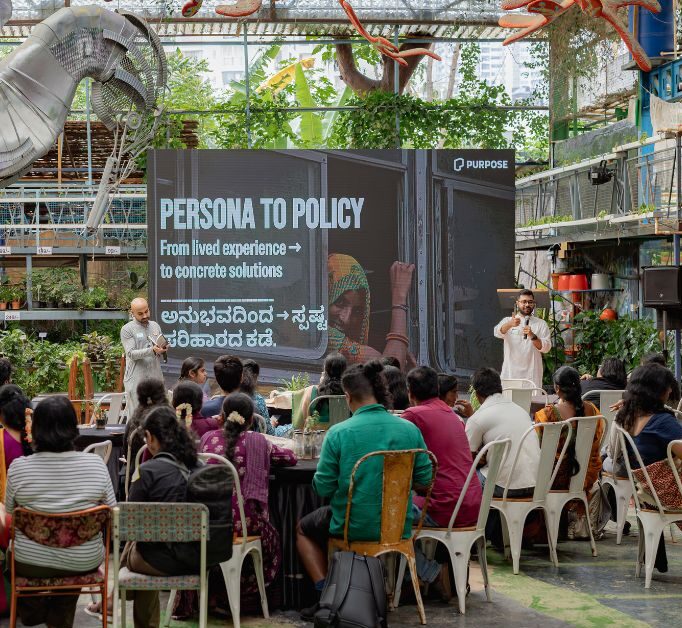
Across India, we have seen what happens when you shift women from passive passengers to active urban planners. In Bengaluru, the Alli Serona collective of informal workers audited their neighborhoods. They mapped failing streetlights and severed footpaths, and highlighted their lack of access to the city they lived in, to successfully advocate for entirely new bus routes. In the capital, the Help Delhi Breathe coalition trained women construction workers to map air quality and demand localized interventions. And through the Sustainable Mobility Network, we are leveraging pan-India data to prove that fare subsidies must be matched with safe, last-mile pedestrian infrastructure.
This is the blueprint for the next decade of sustainable transport. The unprecedented investments and strategic focus around energy policies and finance globally, gives us the opportunity to build out new mobility frameworks and dimensions of inclusive access in Global South cities. Frameworks and systems that minimise the hidden penalties of the last mile, and that recognize that the women navigating these cities are not just an economic dividend waiting to be realized; but the very architects of our urban survival.