The Outside Track: From Courtrooms to Public Momentum
Siddharth Pathak, Senior Director Global Climate Strategy
Our collective resolution for 2026 must be to accelerate action to confront the climate crisis. While there are encouraging signs—such as declining coal use among some of the world’s largest emitters—we are simultaneously witnessing alarming shifts in weather patterns, particularly in vulnerable ecosystems like the Himalayas, where communities are now experiencing “snow droughts.” These contrasting realities underscore the urgency of the moment.
Climate change demands a response that commands sustained political attention, resources, and collective energy but what we are witnessing in many countries is the opposite. While governments are in the important implementation phase of their climate commitments, political support and public enthusiasm for climate action is waning in several countries—even as climate impacts intensify and fall disproportionately on vulnerable communities. In this context, climate litigation has emerged as one of the most powerful tools available to allocate responsibility and enforce accountability. It has reinforced the polluter-pays principle, particularly in relation to corporate responsibility for emissions, and in many geographies now serves as the final backstop against political backsliding on climate commitments.
At Purpose, we believe climate litigation has moved far beyond a niche legal strategy. It is now a growing global movement reshaping how climate responsibility is defined and enforced. Crucially, its power extends well beyond legal outcomes. There is a strong and increasingly strategic relationship between what happens in courtrooms and how climate stories are told in public. Complementing legal strategies with public engagement and narrative-building is no longer optional—it is essential.
Narrative-building alongside climate litigation strengthens both impact and resilience. It inspires others across the climate movement, accelerates action, and extends the reach of individual cases beyond verdicts. It also provides insurance against courtroom defeats, ensuring that cases continue to shape public understanding and political pressure regardless of outcome. Strategic narratives help declutter contested information environments, counter misinformation with human-centred stories, create accountability beyond formal rulings, and safeguard the right to advocate by keeping civic space active throughout long legal processes.
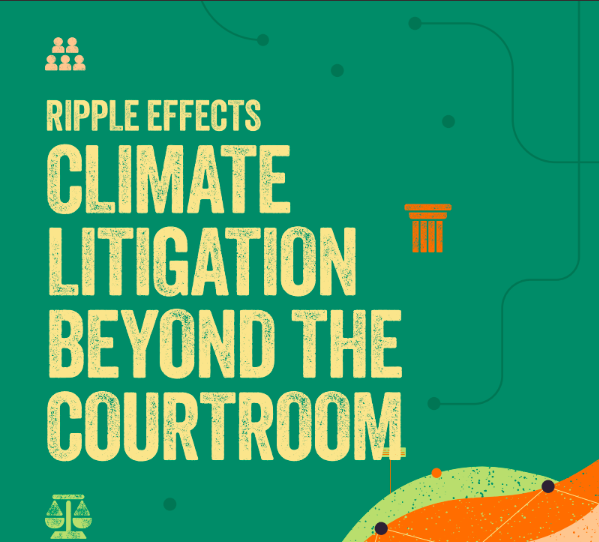
To help enable this “outside track,” we developed the report Ripple Effects: Climate Litigation Beyond the Courtroom. The report draws on a survey of organisations working on climate litigation, an analysis of ten prominent cases, and in-depth social listening focused on Lliuya v. RWE and the 2025 ICJ advisory opinion.
The report’s key recommendations include: situating litigation within broader climate movement narratives; integrating narrative strategy from day one; framing facts through values, not just evidence; centring protagonists and lived experience; sustaining momentum between legal milestones; and anchoring cases in existing cultural stories that audiences already recognise.
Beyond analysis, the report offers practical, step-by-step guidance on building strategic narratives and understanding how different social media platforms can be used at various stages of a case to sustain engagement and inspire action.
Ultimately, this report is intended as a tool—to empower organisations working in climate litigation to confidently build campaigns beyond the courtroom. As the climate crisis deepens, litigation will remain central to closing the gap between climate ambition and political action. By translating moral responsibility into legal obligation, climate litigation is helping turn climate commitments into enforceable reality.
Read Ripple Effects: Climate Litigation Beyond The Courtroom below: